

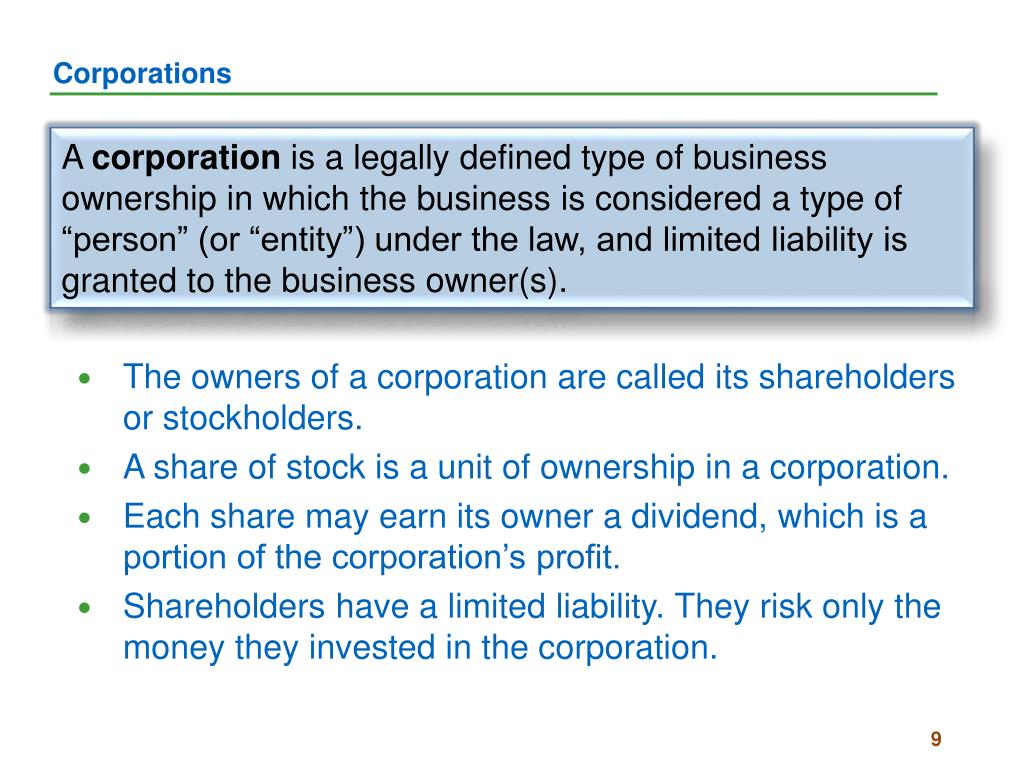
An organization company is a kind of entity that is recognized as separate from its owners, that are called investors. This splitting up is crucial as it supplies the shareholders with restricted responsibility, meaning their individual possessions are shielded from the corporation's financial debts and lawsuits. Corporations are produced under the regulations of a specific state and can contain one or more people. Establishing up a firm includes several actions consisting of the filing of an "Articles of Unification" with the appropriate state authority, and the development of laws that govern the company's operations. Among the defining functions of a firm is its capability to issue stock, which can be a critical device for raising capital. Shareholders can spend money in the corporation and in return, obtain a symmetrical possession in the kind of supplies.
Once developed, a company has to stick to several regulative requirements, including holding normal meetings, maintaining detailed documents, and submitting annual reports. These demands aid ensure transparency and liability, safeguarding the rate of interests of both the shareholders and the general public. The framework of a corporation usually consists of a board of supervisors and police officers. The board of directors, elected by the shareholders, oversees the major policies and choices of the company and selects the officers who handle the daily procedures. This hierarchical structure is crucial as it aids in defining duties and ensuring efficient management. Additionally, firms go through corporate tax obligations on their revenues, and they have to follow both state and government policies which can vary widely relying on the sector and place of the firm. Recognizing these legislations and effectively handling a corporation can cause substantial development and productivity.
Understanding the Framework and Function of Company Firms
Company firms, as formal entities, play an essential duty in the modern economic climate by uniting sources and efforts to accomplish usual goals, largely creating earnings for their investors. These entities are legally identified and provide a framework where business activities can be brought out effectively and with minimal liability for the owners. At the heart of a firm is the principle of limited obligation, which indicates that the personal properties of shareholders are safeguarded; they are just accountable for their financial investment in the company. This fundamental characteristic not just motivates financial investment and risk-taking yet additionally assists in the pooling of huge quantities of funding essential for major business.
Strategic Value of Company Firm Structuring
Recognizing the critical importance of structuring a business corporation properly is vital for long-term success and strength in the open market landscape. Among the crucial components in this process is determining the most advantageous lawful structure that straightens with the company's goals and operational demands. Whether a business choose a C company, S company, or a Restricted Responsibility Company (LLC), each choice comes with distinct tax obligation ramifications, obligation concerns, and versatility in monitoring and possession that can greatly influence the corporation's future. Owners should consider just how these structures can affect everything from drawing in financial investment to the simplicity of future business growths or mergers. In addition, a well-balanced corporate structure can enhance reliability with stakeholders and give a strong foundation for establishing clear lines of authority and responsibility. This is specifically important in bigger companies where the delegation of functions and hierarchical coverage systems ensure performance and clearness in decision-making procedures. Strategic structuring likewise allows companies to much more efficiently handle dangers by clearly delineating liability and securing individual assets of the owners from company debts or lawsuits. Inevitably, a smartly designed corporate framework is not simply a legal demand but a calculated device that can be utilized to leverage affordable advantage, adjust to market adjustments, and seek long-term growth purposes with greater dexterity and focus.
Strategic Administration and Corporate Administration in Service Corporations
In contemporary service corporations, calculated administration and business administration play crucial functions in forming the organization's direction and ensuring its compliance with legal guidelines and moral requirements. Strategic administration refers to the methodical planning, analysis, and implementation of actions aimed at securing an affordable advantage out there. It entails a deep understanding of the market characteristics, consumer habits, and technical improvements to make enlightened choices that steer the corporation in the direction of lasting success and sustainability. Corporate administration, on the other hand, includes the mechanisms, processes, and relationships whereby firms are regulated and routed. It concentrates on stabilizing the interests of a business's many stakeholders, such as investors, monitoring, customers, suppliers, sponsors, government, and the neighborhood. While critical administration is concerned with the functional aspects of a business, corporate governance take care of the structure within which these procedures are performed, ensuring openness, responsibility, and fairness in company tasks. With each other, these two disciplines guarantee that a company not only thrives in a competitive environment however additionally keeps a robust moral stance that strengthens its reliability and longevity in the market. The fusion of tactical administration and corporate administration has become progressively relevant in the digital age, where rapid technological changes can considerably alter competitive landscapes and customer expectations, necessitating dexterous feedbacks and foresighted governance techniques. This harmony is critical not only for attaining business objectives however likewise for fostering a business society that focuses on integrity and social responsibility.
Strategic Monitoring and Competitive Advantage in Company Firms
In the dynamic sphere of business, firms encounter the continuous difficulty of preserving an one-upmanship to make certain lasting growth and productivity. Strategic administration becomes a critical mechanism, encouraging companies to synergize their sources, capacities, and core expertises to surpass rivals. This involves not just the formula however also the application of forward-thinking techniques that are aligned with the firm's long-lasting objectives and the unpredictable nature of market needs. A considerable aspect of critical management is the evaluation of outside market conditions, consisting of competitor movements, technical developments, and regulative adjustments, which can substantially alter competitive landscapes. By taking part in extensive ecological scanning, companies are much better outfitted to prepare for changes and adapt their approaches accordingly. Notably, the role of advancement in business strategy can not be understated. Companies that pioneer new innovations, business models, or market strategies can establish sector standards, leaving rivals to adhere to in their wake. The cultivation of a solid corporate culture that accepts adjustment and fosters innovation is crucial for the successful implementation of calculated initiatives. Basically, https://lowry-just.thoughtlanes.net/beach-body-business-opportunity-1748481510/ of calculated management and the quest of development serve as cornerstone elements that enable organizations to protect a competitive benefit and navigate the complexities of the international market.